Showing posts with label books. Show all posts

Tuesday, April 24, 2012

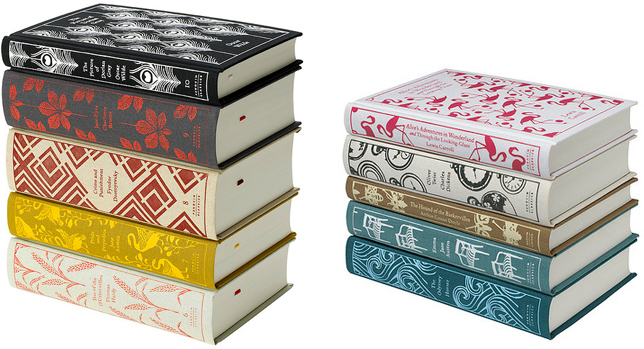
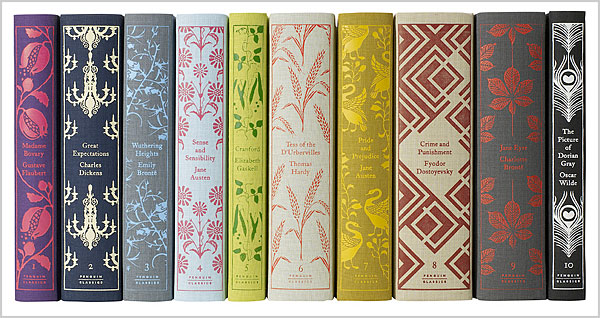
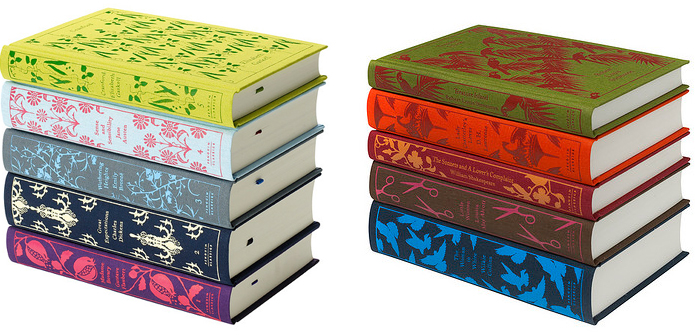
Filed in: Beautiful Books

Links I love! (Because I have nothing to offer you but the possibility of procrastination)

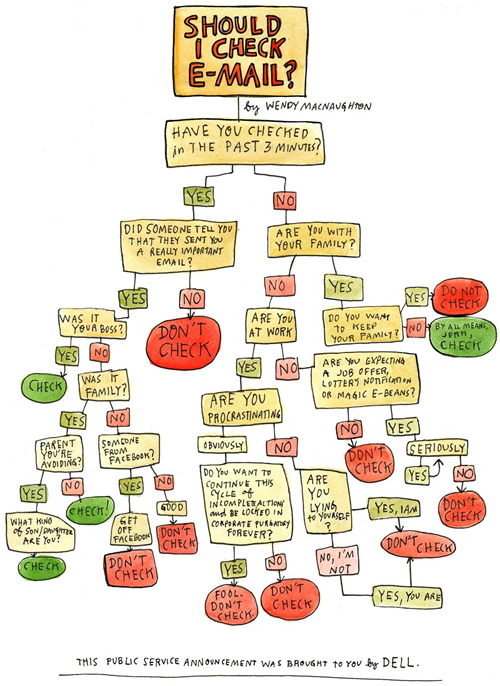
And finally, if you are a slave to your inbox like many corporate drones today:

Monday, April 16, 2012

A short book report: Hector and the Search for Happiness


One of the nice books I've read in 2012 is Francois Lelord's Hector and the Search for Happiness. The premise for this book is simple, Hector is a young shrink who's done everything right. Yet, the feeling of listlessness and confusion won't leave Hector as he continues to see that his patients are persistently unhappy. He realizes that despite his excellent training and sympathetic ear, he doesn't really know how to help them find happiness as he doesn't know what it is himself. Even worse, he finds himself becoming increasingly drained and dissatisfied by his own life--in many ways, he is as lost as his patients. Leaving everything behind, including his uncertain relationship with a pharma exec named Clara, Hector books a vacation with a mission--to travel the world in search for happiness. What makes people happy? What makes people unhappy? He searches the world far and wide (exage, Reisha) to seek the truth and find meaningful answers to his questions. 

In his first stop (China), he meets a lonely businessman trapped on the money-making treadmill, a prostitute who teaches him about love, and a monk high up in the mountains who asks him to return once his journey is complete. In Africa, he meets a doctor working with very poor patients, holds a conversation with a drug lord and a bartender and runs into the local mob. On his last stop in the United States, Hector sees a "happiness expert", one that helps him piece through all of the realities he has seen and experienced during his travels. There, Hector manages to draw a few more conclusions about the connection between happiness and relationships. 

Here are the lessons that Hector has learned in the course of his travels, how or why did he come to these conclusions, I'll leave for you to find out. Buy the book! The writing is simplistic but the plot is very nicely laid out--expect a hard hit of wanderlust and  heaps of existential thinking to kick in afterwards. As always, enjoy!

Lesson 1- Making comparisons can spoil your happiness.
Lesson 2- Happiness often comes when least expected.
Lesson 3- Many people only see happiness in their future.
Lesson 4- Many people think that happiness comes from having more power or more money.
Lesson 5- Sometimes happiness is not knowing the whole story.
Lesson 6- Happiness is a long walk in beautiful, unfamiliar mountains.
Lesson 7- It’s a mistake to think that happiness is the goal.
Lesson 8A- Happiness is being with the people that you love.
Lesson 8B- Unhappiness is being separated from the people that you love.
Lesson 9- Happiness is knowing that your family lacks for nothing.
Lesson 10- Happiness is doing a job that you love.
Lesson 11- Happiness is having a home and a garden of your own.
Lesson 12- It’s harder to be happy in a country run by bad people.
Lesson 13- Happiness is feeling useful to others.
Lesson 14- Happiness is to be loved for EXACTLY who you are.
Lesson 15- Happiness comes when you feel truly alive.
Lesson 16- Happiness is knowing how to celebrate.
Lesson 17- Happiness is caring about the happiness of those you love.
Lesson 18- The Sun and the Sea make everybody happy.
Lesson 19- Happiness is not attaching too much importance to what other people think.
Lesson 20- Happiness is a certain way of seeing things.
Lesson 21- Rivalry ruins happiness.

How about you? Are you happy with the life you lead? Do you get to reflect on things while you travel? Do you write about them? I hope so. I find that one of the exciting pleasures of leaving is the opportunity of coming back a changed person--a smarter one, at least. 

Read so hard, libraries want to fine me.

How can you not love a rap song with a line like, "You use a Kindle? I carry spines..."


"He said Shay let's get married at the Strand, his Friday Reads so bad, he can't have my hand."
"Nerdy boy, he's so slow. Tuesday, we start with Foucault. He's still stuck on the intro? He's a no goooo."
"That shit cray. Explainy, ain't it, A? What you readin'? (de Montaigne)"
"You ball so hard? Okay, you're bowling but I read so hard, I'm J.K. Rowling." 
"War and Peace? Piece of cake. Read Tolstoy in three days, straight through, no delays, didn't miss a word, not one phrase"


And my personal favorite, "Burroughs, Golding, Shakespeare--all dead". Hahaha. Tangina this. 


This print's rare,
R

Tuesday, November 15, 2011

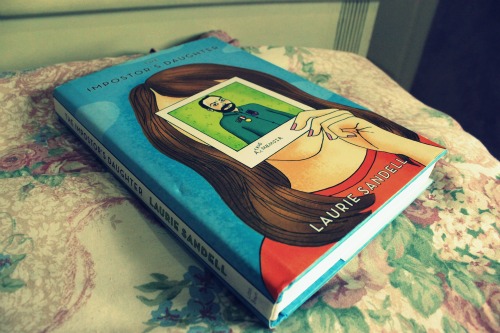
The Impostor's Daughter


This is my cousin's book and it's awesome so I thought I could write about it a bit to take my mind off the book I am currently reading (An expat's memoir about France, one that is so honestly written that it's just full of raw beauty. I am filled with so much wanderlust and I am not even halfway through! I guess it also helps that for every French man a heroine meets, I instantly imagine Yoann Gourcuff). 

First, a summary: Laurie Sandell grew up in awe (and sometimes in terror) of her larger-than-life father, who told jaw-dropping tales of a privileged childhood in Buenos Aires, academic triumphs, heroism during Vietnam, friendships with Kissinger and the Pope. As a young woman, Laurie unconsciously mirrors her dad, trying on several outsized personalities (Tokyo stripper, lesbian seductress, Ambien addict). Later, she lucks into the perfect job–interviewing celebrities for a top women’s magazine. Growing up with her extraordinary father has given Laurie a knack for relating to the stars. But while researching an article on her dad’s life, she makes an astonishing discovery: he’s not the man he says he is–not even close. Now, Laurie begins to puzzle together three decades of lies and the splintered person that resulted from them–herself.

This will be short. You see, it's kind of hard to talk about graphic novels at length without getting into the illustration or giving away the story itself. Now that I already gave you the summary, I can also go ahead and say that this gem of a book has wonderful coloring (which is the only thing I could say about the technical aspect of the illustration, as I am not an expert). Truth be told, I've seen better drawings from, say, Craig Thompson, Adrian Tomine or even Lucy Knisley, but this book aces coloring (I realize it's completely wrong to compare illustrators because they differ in technique but I am a Philistine in illustration. I am not useful in articulating drawing differences or peculiarities at length). A story this complicated and somewhat dark can easily be translated into even darker drawings but this book did not. The illustrations remained warm and lively, and I really liked that. It didn't give the story any added weight, and it gave me (as a reader) something nice to look at, no matter how depressing Laurie's story got. There was balance and it was really essential in holding my attention, especially when everything got messy (and just atrocious). It is especially disconcerting for me because like Laurie, I loved my father a lot. It made me realize that even our greatest heroes are people too. And as most people, they are susceptible to shortcomings and human frailty. I admit I have the tendency to put the people I love in pedestals. This book made me realize that it shouldn't be that way all the time and if I insist, I'd have to always look away. I don't want that. In my book, blind deference is almost as ugly as the bitter truth.

In the end, (and I'll try not to spoil you as much as I can) Laurie was able to overcome the truth that she has unraveled by turning the other cheek. Giving people a free pass on their many shortcomings may be unacceptable to some, and I will be the first to admit that I am yet to learn the redeeming value in forgiveness of that kind, but Laurie and her siblings were able to do it. They were able to love their father the same way, even if he wasn't what he said he was. I first thought it was a little bit defeatist, letting things be like that but later on, I realized that forgiveness, in whatever form, is great.

Then, of course, the book has frames of this kind which I found raw but funny. Although I would never advocate what Laurie did, (the whole blame game, I'm lost with a lot of daddy issues thing? Just no) I enjoyed reading about it. Two wrongs don't make a right, kids, but they make for one hell of a story (and a book deal, if you're as lucky):
PS. You can learn more about the book (there are excerpts!) and the author in this interview with Jezebel

Tuesday, October 18, 2011

44 Bookers in 25 Words Each


The Man Booker Prize, for the best novel published in the past year by a citizen of a country in the British Commonwealth or the Republic of Ireland, is one of the most prestigious literary accolades given for a single work of fiction in the English-speaking world. In light of the October 18th announcement of the 2011 prize, the Review's editors asked Harold Augenbraum, Executive Director of the National Book Foundation, presenter of the U.S. National Book Awards, to provide a bite-sized "take" on each Booker or Man Booker recipient (its sponsorship changed in the 1990s). He responded with precisely 25 words on each and every winner.


1969 -- Something to Answer For by P. H. Newby -- Who? Shockingly good. Graham Greene crossed with Steve Erickson: Personal and political melt into a man without memory. Appropriate that the Booker was a newbie.


The Elected Member1970 -- The Elected Member by Bernice Rubens -- Abraham and Sarah raise a different sort of dysfunctional brood. This is Sholem Aleichem's "Tevya and His Daughters" made into a wonderfully contemporary, psychological novel.


1971 -- In a Free State by V. S. Naipaul -- No one writes better about how oppression oppresses everyone it touches, including the oppressor. The book's last section is subtly complex and brilliantly nuanced. Marvelous.


1972 -- G. by John Berger -- Truly a reader's book, with hints of Marx and Stendhal and Robbe-Grillet hiding within. No one mixes reason and art like Berger, every sentence intriguing.


1973 -- The Siege of Krishnapur by J. G. Farrell -- Start with a measure of stupid British commercial imperialism, add spoonfuls of ironic heroism, Anglican bible-thumping, and Victorian sexual naiveté. A real romance of cynicism.

The Conservationist1974 (shared) -- The Conservationist by Nadine Gordimer -- Everyone talks about Gordimer and race in South Africa, but she's an incomparable artist with words, on every page a gem worth repeating to friends.


1974 (shared) -- Holiday by Stanley Middleton -- Middleton shows consummate craft in an exploration of marriage told in flashback. So many Bookers take place near water; it should be the (Sea)Man Booker.

1975 -- Heat and Dust by Ruth Prawer Jhabvala -- Hard to believe that this book was written by a German-Jewish woman from Britain. A stingingly vivid embedding of alienation in an alienating country.


1976 -- Saville by David Storey -- I love British class-accent-based coming-of-age novels that civilly depict uncivilized behavior. Sons and Lovers without the paternal abuse and Lawrence's overbearing ideology, an immerging story.


1977 -- Staying On by Paul Scott -- This belongs to the "What were we thinking?" School of British Literature. It's not post-colonial, it's post-purpose. Read it with Scott's Raj Quartet: They intersect.
The Sea, The Sea
1978 -- The Sea, The Sea by Iris Murdoch -- Insightful story of a retired man who pretends that forty years of an unfulfilled life do not exist. Intellectually intriguing and emotionally compelling: A masterpiece.


1979 -- Offshore by Penelope Fitzgerald -- Creeps up on you, like the tide, with great story rhythms. Chock-full of pathos, few sentences stand out, but the whole makes up for it.


1980 -- Rites of Passage by William Golding -- When historical fiction overlays contemporary sensibilities onto the past instead of trying to approximate that era's sensibilities (see The French Lieutenant's Woman), a corker results
Midnight's Children
1981 -- Midnight's Children by Salman Rushdie -- Winner of the Booker of Bookers (twenty-fifth and fortieth anniversaries). Not only one of the best but most representative of what the Bookers look for.


1982 -- Schindler's List (published in the U.K. asSchindler's Ark) by Thomas Keneally -- Novel? History? Doesn't matter. Keneally smartly situates victims and survivors at the center. Powerful reminder of when compassion battles brutality…and wins…but only sometimes.


1983 -- Life & Times of Michael K by J. M. Coetzee -- It may be a cliché, but this book is like a traffic accident observed in slow motion. You grimace constantly but you can't look away.


1984 -- Hotel du Lac by Anita Brookner -- As languidly sensual as the English get (again with the water!). In America they would call this a "snowbound" book, a modern classic of regret.


1985 -- The Bone People by Keri Hulme -- Reads like it was tapped out on a manual typewriter in a wilderness shack by a first-timer. Visceral and affecting. Among the Bookers, sui generis.


1986 -- The Old Devils by Kingsley Amis -- Codgers and regrets go together like horses and carriages. Not Amis's best, but it's a cohesive portrait of aging curmudgeons by the quintessential aging curmudgeon.


1987 -- Moon Tiger by Penelope Lively -- The most attractive, unrepentant female curmudgeon ever, passionate sex, intellectually exciting, and socially upending. My first Fitzgerald: couldn't put it down, will read it again.
Oscar and Lucinda1988 -- Oscar and Lucinda by Peter Carey -- Carey specializes in extraordinary people in uncivilized environments. His language grows more ambitious with each book, with greater risks and more accomplishment. Read 'em all


1989 -- The Remains of the Day by Kazuo Ishiguro -- I have read three perfect novels in my life, and this is one of them. The British class system as realism, symbolism, and metaphor. Brilliant.


1990 -- Possession by A. S. Byatt -- One hopes that literary prizes get it right sometimes. This is one of those times. Read slowly and carefully, and don't skip over the poetry.


1991 -- The Famished Road by Ben Okri -- Raises the coming-of-age novel to the thrill of epic, candidate for the Great Nigerian Novel. Okri is a worthy successor to Achebe, predecessor to Adichie.


1992 (shared) -- Sacred Hunger by Barry Unsworth -- A post-swashbuckling saga of corrupt antiheroes on the Main, highly structured and powerfully languaged, a call-and-response plotting of moral relativism before the British abolition of slavery's Triangle Trade.


1992 (shared) -- The English Patient by Michael Ondaatje -- The love stories twist you in knots while the beauty of Ondaatje's language creates an internal landscape to match the sublime vastness of the desert.


1993 -- Paddy Clarke Ha Ha Ha by Roddy Doyle -- The title explains much of it. A kid's romp in the not-quite-mean streets, and one of the best evocations of the "loomingness" of childhood.


1994 -- How Late It Was, How Late by James Kelman -- Who hasn't awakened in an alley missing his shoes? Portrait of the downsliding of a soon-to-be down-and-out, the prose style mirrors the story's blithery content.
The Ghost Road
1995 -- The Ghost Road by Pat Barker -- One of the best "if war is hell then the First World War is heller" subgenre books of political conflict writing. Like someone's dark soul imprinted.


1996 -- Last Orders by Graham Swift -- A really affecting novel of community and 
regret, though since The Big Lebowski no one can throw a crematee into the sea without comic relief.


1997 -- The God of Small Things by Arundhati Roy -- One of those books that people say you should read because of its themes; instead, read it (aloud) for the sheer pleasure of hearing words


1998 -- Amsterdam by Ian McEwan -- McEwan is Britain's big-concept, zeitgeist writer, whose personal stories engage with political ideas. Always intelligent and readable, Amsterdam's his take on death and dying.


1999 -- Disgrace by J. M. Coetzee -- Coetzee could win the Man Booker with every book. A man steadily loses control; in the face of gathering darkness, his social presence turns translucent.
The Blind Assassin
2000 -- The Blind Assassin by Margaret Atwood -- Character-driven and illusive, the dissatisfactions of women intertwine in the fictions they tell themselves and one another through the generations. Kate Chopin meets Robertson Davies.


2001 -- True History of the Kelly Gang by Peter Carey -- For Americans, a revelation that other places had legendary bandits (Robin Hood? Joaquin Murrieta?). Carey's fabulous style creates a link between language and life story.


2002 -- Life of Pi by Yann Martell -- The fable that made the Booker fabulous, mingling Robinson Crusoe, Steinbeck's story "Lifeboat," Animal Planet, and Khalil Gibran. Don't believe the overhype: It reads good.


2003 -- Vernon God Little by DBC Pierre -- The least British British novel I've ever read. Absorbing, more Denis Johnson than Samuel Johnson, with gangly prose as if written by a stringy convict.


2004 -- The Line of Beauty by Alan Hollinghurst -- Class and sex, sex and class. It beautifully brings out the 
status of gay men as "ethnics," in an otherwise traditional British tale of "passing."
The Sea
2005 -- The Sea by John Banville -- Another Booker about old men and the sea (see Murdoch, 1978). Few novelists write more beautiful prose than Banville…and most of them are dead.


2006 -- The Inheritance of Loss by Kiran Desai -- It's hard not to admire this book. A big, heart-rending story of Indians who leave and Indians who stay, and those who came and went.


2007 -- The Gathering by Anne Enright -- Very earnest story of sex, death, family, and middle-age desire. The sentences are so astoundingly ambitious that their risk-taking beauty can keep you from sobbing.


2008 -- The White Tiger by Aravind Adiga -- Surprisingly good, because some literary pundits badmouthed it for lack of complexity. The best of what happens when a journalist writes a socially relevant novel.
Wolf Hall
2009 -- Wolf Hall by Hilary Mantel -- English history is a fetish for the Brits, like Star Wars for the Yanks: They love to parade in costumes and jostle with their (anti)heroes.


2010 -- The Finkler Question by Howard Jacobson -- We've been waiting 800 years for the British Messiah, but instead of a messiah we get messhugah. Also read Kalooki Nights. It's even better.


This piece is by . He is the Executive Director of the National Book Foundation, presenter of the U.S. National Book Awards. Asked what his favorite Booker Winners and Short List selections have been over the past 42 years, he responded, "The Sea, The SeaThe Sea; and C."

Monday, October 17, 2011

A time for everything

Manila, 01:05 AM. A glass of Shiraz and Marcel Pagnol's The Time of Secrets and The Time of Love. 

Friday, October 7, 2011

Friday Wings

Friday Flaming Wings


I stayed up late the night before, working on a deadline about something that was not very much fun to do, so I thought I could use a very cheap order of buffalo wings from Flaming Wings the day after. I have some chicken wings sitting here at home so I'm going to try and make my own version although I'm scouring the web for recipes with just a mild kick. I've already been through Rachel Ray's videos but I got nothing except a small feeling that she might have a touch of Asperger's. That, and she must own the saltiest rug in all of America. 

Also: I'm starting The Lazarus Project by Aleksandar Hemon for the nth time (that's the book you sort of see in the picture). I really want to like this book but I can't even get past four chapters. I'll try better this time though. :( 

Monday, October 3, 2011

Fat Girl

IMG_3788
This is a childhood memoir about a girl who grew up fat, loved fat, hated fat, and how she almost set-up the life she had/has around being fat.

Thursday, September 29, 2011

The Girl's Guide to Waking Up in Pieces

Girls Guide to Hunting and Fishing
"I saw my life in scale: it was just my life. It was not momentous. I saw myself the way I'd seen the cleaning woman in the building across the street. I was just one person in one window. Nobody was watching, except me."

I'm not really supposed to be reading this book but it is one of the books I read in between breaks of big books with big words and even bigger feelings. I don't like going through good books in rapid succession. It takes the magic away. So, I read this book. Light, predictable and somewhat hollow, I was going through the pages rather idly, smiling at the few angsty but witty observations scattered across pages, just waiting (and wanting) to reach the end. It went on like that, up until I read one small line:

"We are all children, until our fathers die."

And that was that because I still find myself in pieces, most of the time.

Tuesday, September 27, 2011

Rain and Innocence

The Age of Innocence
Weather in Manila has been terrible these past two days. I hate it when the weather is terrible because people match it with an equally dysfunctional and unpredictable behavior, myself not excluded. Last night, I was not able to sleep well because of the strong winds howling outside my window and today, most of Manila had to put up with power outages that stretched for hours on end. I'm a little bit worried since I have a week full of deadlines and meetings but I know my worries do not amount to a hill of beans in contrast to the damage of typhoon Nesat all over Manila.

Since I couldn't get things done, I went in and out of R.E.M sleep the whole day. I also tried to get myself to like Edith Wharton's The Age of Innocence but I gave up halfway through the book and picked up Michael Ondaatje's The English Patient instead. The prose is definitely better: it's vivid, fluid, passionate, and very rich but not so dated. I feel it's going to be a favorite.

I have not given up on The Age of Innocence though, because I still dream of being well-read in the classics (a lofty dream, if you ask me, but I have my whole life to accomplish this feat). Being the Philistine that I am, I looked up the book online and found out Martin Scorsese directed a 1993 film version starring a young and beautiful Winona Ryder and a dashing Daniel-Day Lewis as main protagonist Newland Archer (who is kind of like a New York City multi-hyphenate in the 1870's). I'm going to watch the film first just so I can get myself to visualize the plot better. Heh.

New York high society, I have to admit, is always a hit or miss on my end. I like New York but I like the bohemian, artsy, tough, won't-take-a-crap-from-anyone city that is New York. It's kind of hard for me to like a satirical novel penned under the guise of old world traditions and high society entitlement. My issues, of course. One day, in the not-too-near future, I know I'll pick up The Age of Innocence again. Hopefully, I will learn to like it then.

Sunday, September 25, 2011

Small notes from my bookshelf: The Happiness Project

IMG_3576
In which I write about a book I can't make up my mind on. 

The Happiness Project. This book is about a year-long self-improvement project to increase happiness, satisfaction and contentment. It's a lot Ben Franklinesque than I thought it would be and I think I can learn a lot from reading this book (although my reading this book has been conveniently scanning the pages and the months because I can't get myself hooked). I'm not really sure if I'm up for a year-long project of my own though.  I'm not even sure if I like this book or not, so I will ramble.

I do appreciate the book's message of simplifying our lives and finding the joy in the small stuff but I can't help but wonder what made her life so stoic and unsatisfactory anyway? She seems to be doing well to me. I'm not sure if it's just me and my thing against First World Problems. Here in Manila, a lot of people live with less than a dollar a day. We really have no room for taking it easy and simplifying our lives because life is tough and simple is what we can afford, most of the time. I loved reading Eat, Pray, Love and Catcher in the Rye but I've always had a thing against the Western world and its lack of resiliency. I got the same vibe when I read this book. Where I come from, people suffer from really devastating tragedies and they just go on with their lives because they need to. Perhaps it's just a matter of perspective. I did like the quotations and the lists. I thought they were pretty crafty and most of the time, the insights made a lot of sense. I don't know. I need to read this book again but if you think you could afford to chase happiness and find out if there are certain things in your life that need to be fixed, pick up this book. It might be helpful. 

Sunday, September 18, 2011

Lucy Lou


Sunday, 05:27PM. I have a schedule I follow but I'm four hours behind because I've been reading Lucy Knisley's Stop Paying Attention comics. I just love her work. I'm glad she moved from Chicago to New York! More stories about my favorite city! (Not that Chicago isn't beautiful, but I could use another person to live vicariously through, actually) ♥

▲ ▲ ▲

Reading day

Saturday, 09:41 PM. I wanted to transcribe my International Law lectures last night but my spirit is weak. The world readily gives me dark chocolate on a regular basis but I haven't had the good fortune of running into it lately so I stole a white chocolate bar from my mother's stash. White chocolate is not chocolate, but my incurable sweet tooth enjoys everything. And by everything, I mean everything, including sweet and fatty triangles of death that are wrapped in foil and sold as chocolates (actually, they're just butter).

So, no International Law notes. I stayed in bed, ate "chocolates" and read until I fell asleep. I am a fat hog.

Saturday, September 17, 2011

"I like my money right where I can see it...on my bookshelves."

Cheap Books

03:30 PM, Book Sale in Mall of Asia, Manila. It's been a shitty day plus it's sale season at the mall, so I passed by a used book store before heading home. I feel happiest (greatest, really) whenever I purchase books that are practically free. Check out my loot! These four books cost just a little over what we pay for a venti cup at Starbucks. I got Michael Ondaatje's Booker Prize-winning novel, The English Patient, for 115 pesos. How can something so brilliant be worth so little? Anyway, it's going to be a great weekend! After I transcribe this week's International Law lecture, that is. :)

Saturday, September 10, 2011

Mass collaboration and Soviet collectivism are really polar opposites


"Anonymous blog comments, vapid video pranks, and lightweight mashups may seem trivial and harmless, but as a whole, this widespread practice of fragmentary, interpersonal communication has demeaned interpersonal interaction. Communication is now often experienced as a superhuman phenomena that towers above individuals. A new generation has come of age with a reduced expectation of what a person can be, and of who each person might become."

"A real friendship ought to introduce each person to unexpected weirdness in the other. Each acquaintance is an alien, a well of unexplored difference in the experience of life that cannot be imagined or accessed in any way but through genuine interaction. The idea of friendship in database-filtered social networks is certainly reduced from that."

"If you want to know what’s really going on in a society or ideology, follow the money. If money is flowing to advertising instead of musicians, journalists, and artists, then a society is more concerned with manipulation than truth or beauty. If content is worthless, then people will start to become empty-headed and contentless. [...] Reciprocity takes the form of self-promotion. Culture is to become precisely nothing but advertising."

Jaron Lanier, You Are Not a Gadget

Thursday, August 18, 2011

Matilda, revisited

"So Matilda’s strong young mind continued to grow, nurtured by the voices of all those authors who had sent their books out into the world like ships on the sea. These books gave Matilda a hopeful and comforting message: You are not alone."

"The books transported her into new worlds and introduced her to amazing people who lived exciting lives. She went on olden-day sailing ships with Joseph Conrad. She went to Africa with Ernest Hemingway and to India with Rudyard Kipling. She travelled all over the world while sitting in her little room in an English village."
— Roald Dahl, Matilda

Tuesday, June 28, 2011

An excerpt from memory

If you haven't seen The Philadelphia Story, stop what you are doing and watch it. It's probably overstating, the point to say that until you watch it, you will have been living a partial and colorless life. However, it is definitely on the list of perfect things. You know what I mean, the list that includes the starry sky over the desert, grilled cheese sandwiches, The Great Gatsby, the Chrysler building, Ella Fitzgerald singing "It Don't Mean A Thing (If You Ain't Got That Swing)," white peonies, and those little sketches of hands by Leonardo Da Vinci.

In college, I took a film studies class in which the professor talked about the trick The Philadelphia Story pulls off. It should never have worked: creating a fantastic love scene between two characters whom you know are not in love with each other, getting you to somehow root for them wholeheartedly during the scene, but then to feel completely satisfied when they end up with other people. Before you get the wrong impression, you should know that I'm not and never one of those film people, the kind who argue into the wee hours about the auteur theory and whether Spielberg is the new Capra, or whether John Huston impacts, in unseen ways, every second of American life. I don't know from camera angles, and I don't have an encyclopedic knowledge of pre-World War II German cinema, but I fell a little in love with the film professor when he looked upon us with shining eyes and proclaimed, "No, it should not work. But work it does!" because he was so passionate and right.

He was so passionate and right.

Friday, April 22, 2011

Flipped

“Some of us get dipped in flat, some in satin, some in gloss….” He turned to me. “But every once in a while, you find someone who’s iridescent, and when you do, nothing will ever compare."


I absolutely love this book-turned-movie. In my humble opinion, the movie was way better than the book (no offense to the author who did a really wonderful job in writing such a simple but truly touching story, it's just a from good to better thing). I love that the movie was set in 1960's. I adored the soundtrack (although most of the songs were from the 1950's-early 60's). It reminded me of long drives with my father. I just loved, loved, loved singing along to Big Bopper's Chantilly Lace, Pretty Little Angel Eyes by Curtis Lee, Da Doo Ron Ron by The Drifters, The Chiffons' One Day and He's So Fine, Crying in the Rain by Nancy Sinatra and one of my favorite love songs, You've Really Got a Hold on Me by The Miracles. Of course, I have the musical sensibility of a grandmother. Does it bother me? Nope. Not one bit.

If you loved Little Manhattan as much as I did (still do, actually), you will love this film. Go watch it. Go read the book as well! :) Happy weekend!

“You have to look at the whole landscape”

“What does that mean?”

“A painting is more than the sum of its parts. A cow by itself is just a cow. A meadow just by itself is just grass, flowers. And the sun, peaking through the trees is just a beam of light. But you put them all together…and it can be magic.”


PS: How gorgeous is Bryce Loski?

I know, right? :D

I'm the boss! I'm the boss!


I like Bossypants. Somehow, in the middle of what is the most unenjoyable summer vacation I have had in years (and I promise, it's not me, it's my family), it was a good leisurely read. I tried my best to find something I do not like in this book (because I absolutely love Tina Fey for reasons that are not even concrete enough to write about, I just do) but I couldn't (except for the excerpts of scripts used in SNL but that's because I have zero background on TV or writing for TV). It's just so hard not to like this book because the writing is straightforward, unapologetic and hysterically funny. The honesty is especially hypnotic. In the world of increasing self-righteousness, I'm glad I was able to read a book that was just as raw and as honest on print as anybody else would should be in real life. (The audio book is even funnier, people say, because it was narrated by Tina Fey!)

Bossypants is a series of short story vignettes about Tina Fey's life. Some critics believe that most of the chapters in the book are just fiction and only a few of them are indeed true. I'm not really sure if I would buy that, actually I'm not really one to care. All I know is that this book was a fun read. It was hilarious. She is hilarious and if you have been in doubt of Ms. Fey being worth her mettle, pick-up a copy of this book and see for yourself. That woman deserves more distinction. On top of her seven Emmy's.

My favorite stories from the book: That's Don Fey, 30 Rock: An Experiment to Confuse Your Grandparents, Sarah, Oprah, and Captain Hook, or How to Succeed by Sort of Looking Like Someone and All Girls Must Be Everything.

But really, if you must buy this book, buy it for That's Don Fey. Women on top of their game were raised by great fathers. Badass, boss fathers.

Either way, everything will be fine. But if you have an opinion, please feel free to offer it to me through the gap in the door of a public restroom. Everyone else does.
-Tina Fey, Bossypants

Saturday, April 2, 2011

On to happier things

Books are my total mood boosters! The past few months have been a blur of hectic schedules, stress eating and quarter life crisis-ing (mostly because I want it ALL in one time and it irks me that the Universe is adamant on teaching me a little something about patience) but I get by through a lot of rallying, dreaming and purchasing. The last great book I read was The Accidental Billionaires by Ben Mezrich a few weeks ago (in the middle of tests and all, but I roll like that. I am a masterclass in prioritizing the most trivial things). I got hooked on Mark Zuckerberg and his information-privy empire. People like the Zuck are so inspiring and of course, stories like this (manifested in shows and books) make us forget about the boring daily grind.

This week, I have been dying to watch The Borgias, a new show from Showtime US about this prominent Spanish renaissance family who came to power in Rome. I'm pretty sure I'm not the only one who's got a love for shows about deceit, sex, money, religion and power plays in old world affairs. Cesare Borgia inspired Niccolo Machiavelli's The Prince, Lucrezia Borgia had an incestuous reputation, Pope Alexander VI's ascent to papacy was as infamous as the corruption that happened while he was Pope. God, this show has so much material to work with! Anyway, the Secret seems to be at work today because as soon as I got home from work, I found a lovely surprise...
Borgias and their enemies
Borgias 1
Lucrezia Borgia, on hearing that her father, Pope Alexander VI, was choosing her third husband, noted that her first two had been “very unlucky.” Luck had little to do with it, as Hibbert shows in this vivid chronicle of the notoriously corrupt Renaissance family. One husband was killed on the orders of her brother Cesare, whose ruthlessness made him the model for Machiavelli’s “The Prince”; the other was discarded after ceasing to be politically useful to the Pope. Hibbert ably traces the web of alliances through which the Spanish-born Alexander hoped to secure his hold on Italy and his family’s place in power. But his prose often demonstrates the costume-drama pitfalls of popular history: too little analysis and too many “almond pastries filled with honey and nougat,” which Lucrezia ate “in the steaming water of her bath or while playing idly with her countless pearls.” - from The New Yorker

It's kind of exciting that I happen to be in possession of a book on this show I have been so interested to watch. I will be the first one to admit that I don't know much about the Borgias (I have the bloody Tudors of England and their "religious" wars to blame!) so imagine my excitement when, upon checking my bookshelf, I find out one of the books my grandmother sent me from New York was about this family! Aaaah! It's the little things that make me extremely happy (that and the fact that with school ending in a week, I can finally have a break from juggling work and graduate studies!). :)

Hope you're also discovering small surprises this weekend. I love weekends!